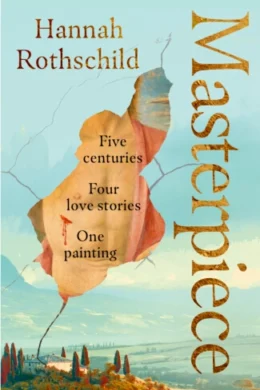
Masterpiece is a multi-timeline art-reverence novel built around Piero della Francesca’s The Resurrection in Sansepolcro. It alternates between four strands — the artist who paints it, the Bloomsbury-adjacent muse who helps turn it into legend, the soldier who saves it during the Second World War, and the modern conservator who restores it after an earthquake. It wants to be a hymn to art’s survival across time, a novel about courage, queer love, women’s erased lives, conservation science, war, patronage, and the power of looking. Mostly, it is an over-pious, over-arranged chain of art-history sermons in which every character stands before the same painting and reaches the same conclusion: life is hard, art endures, begin again.
The painting itself appears at the start, reproduced on the page like an icon the novel expects the reader to kneel before. From that point on, the book has only one emotional strategy: insist, again and again, that this fresco is not merely a painting but a time machine, spiritual engine, moral test, life raft, erotic catalyst, civic emblem, and proof that humanity is worth saving. That is a lot of symbolic weight for one wall.
The first strand begins in Sansepolcro in 1470, during a punishing drought. Piero della Francesca has been commissioned to paint The Resurrection for his hometown. His brother Marco, a wheezing, greedy merchant, has turned the work into public spectacle, selling seats in the square and treating genius as a commercial fairground. Piero, meanwhile, is paralyzed by the impossibility of painting the Resurrection, an event no human witnessed. He has the geometry, the perspective, the studies of limbs and armor; what he lacks is life.
Continue Reading for Free
Enter your email address to unlock the article and keep reading it for free.