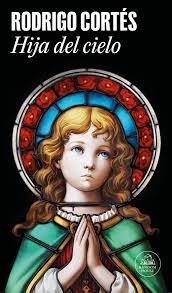
Hija del cielo begins in Gabaón, an isolated village on the northern coast, dominated by the Colegio de la Estricta Observancia de Gabaón, an institution that is simultaneously a school, orphanage, former seminary and quasi-monastery. It stands above the sea, populated by poor boys, more than sixty nuns and a small number of priests. Its real ruler is Father Alén, an elderly priest in his eighties who was once a mason, studied in Rome and has spent decades reshaping Gabaón according to his own peculiar understanding of religion, discipline and order. Alén is obsessed with the seasons, especially autumn, which he regards as the time when death, decay and hidden truths rise to the surface. The novel quickly reveals the institution’s greatest secret: on the fourth floor, in a room without windows, a teenage girl is being kept under lock and key. The girl, who comes from the rural village of Orate, narrates many chapters herself in a frantic, repetitive, childlike voice. She is thirteen when the story begins and later turns fourteen. She insists that she is not stupid and describes strange “vacíos,” blank periods in which she feels herself disappear. During these episodes she hears a mysterious presence she calls the Hombre Guapo, the Handsome Man, whose voice sometimes calls her “rata,” or rat. Long before arriving in Gabaón, she displayed frightening behavior. She bit animals and people, attacked her parents, behaved violently at school, manipulated other children and apparently possessed abilities that go far beyond ordinary aggression: she can influence minds, know things she has not been told, move people or objects without touching them, enter dreams, foresee events and make people physically ill simply by concentrating on them. Her own morality is almost nonexistent. She recounts cruelty with the same cheerful curiosity with which she describes food, plants or geography, and later casually admits that she has killed a goat, a dog and even a child. She was first sent to Madrid’s Hospital Bernabé, where doctors could find no conventional explanation for her. There she attacked guards and began controlling other patients. She made one woman pray obsessively, another run through the corridors shouting that nobody was insane, and persuaded a mentally healthy woman confined by her family to behave like a chicken. That woman ultimately jumped from a second-floor window after the girl convinced her she could make a short flight. Unable to manage her, the hospital transferred her to Gabaón through Father Solitude, an extraordinarily handsome, wandering priest who recognized something unusual in her. At Gabaón she initially slept near the nuns, but she began “fascinating” them too. Eventually she was isolated in the windowless room and sometimes strapped down. Her greatest desire is simply to see the sea, which she can sense beneath the cliff even though Alén refuses to give her a window.
The middle of the book gradually reveals that Gabaón is not merely a religious school attempting to cure a disturbed child. Father Alén has dealt with girls like her before, and the institution appears to exist partly to repeat an ancient experiment whose exact theological purpose has become obscure even to the people carrying it out. Alén is both fascinated and terrified by the girl. He visits constantly, questions her and tries to determine who is speaking when her language suddenly becomes more sophisticated than anything a village child should know. One important confrontation occurs when he asks her to recite the Lord’s Prayer. She recites it perfectly, but then begins “correcting” it: God’s name should not be sanctified, she says, but his skin; his kingdom should become triumph; God should not keep people from temptation but actively tempt them so that he can discover what they really are; and instead of delivering humanity from evil he should crush human beings like insects. She finally compares this crushing power to the Hombre Guapo. Alén understands that at that moment he is not entirely speaking to the ordinary girl. Around them, the major inhabitants of Gabaón develop into a strange occult family. Sister Adriana is the institution’s practical authority: she manages finances, records, meals, medical matters, schedules and almost everything Alén pretends to control. She and Alén have loved each other for decades in a highly restrained, quasi-mystical way. Their intimacy consists less in sex than in proximity, trust and the memory of lying clothed beside each other and touching little fingers. Sister Maite is a botanist and herbalist whose greenhouse mixes medicinal knowledge, superstition, magic and outright witchcraft. She prepares the bitter infusions given to the girl and becomes delighted when strange marks appear on her body. Sister Humilde, ancient and almost silent, acts as a formidable caretaker. Father Salcedo, young, anxious and deeply unhappy, sees dead children, steals communion wine and is ordered by Alén to memorize a complicated ritual. Solitude, meanwhile, keeps leaving Gabaón and returning from mysterious journeys, functioning almost as a supernatural scout.
The girl’s body and mind change with the seasons. Spots appear on her skin, then become wounds. Her speech sometimes becomes far more abstract and poetic, as though other memories and languages are entering her. She dreams of people she has never met and later discovers that some of them, such as the Italian nun María Tamata, really exist. Maite tells her that some people have several lives, that Alén and Adriana may have existed in other forms before this life, and that the girl herself is simultaneously ancient and new, carrying something enormously old within her. The girl also knows of something that Alén desperately wants to understand: an immense underground lake beneath Gabaón. She describes a cavern larger than the school, filled with blind fish and impossible darkness. The nuns sometimes descend there; when Adriana goes down, according to the girl, she produces light and the shadows themselves move. Alén admits that he cannot descend because he is a man. Adriana later insists to him that the lake does not exist, although her evasiveness suggests that this denial is deliberate. Most importantly, Alén finally tells the girl that Gabaón receives a girl every year. Because no girl came the previous year, he says, she effectively counts as two. His previous attempts have failed in grotesque ways: one girl was left mentally destroyed, another lost her legs, another went mad, and the arm of a dead one was preserved to see whether it would decay. It did. The metaphor Alén uses is that of repeatedly baking a soufflé: every year it rises, only to collapse, and he continues hoping eventually to produce one that remains permanently transformed. His purpose is therefore not really to cure the girl in any medical sense. He is trying to make something spiritually stable out of her.