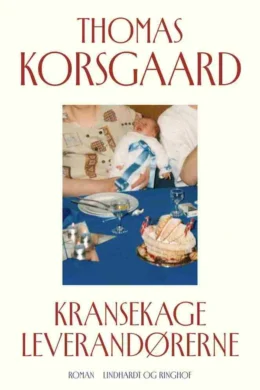
The novel is narrated by Tommy, an eleven-year-old boy living with his parents, Carina and Henning, and his three younger siblings in a financially strained household in rural Denmark. From the beginning, it is obvious that something is seriously wrong with Tommy’s relationship with school. He hides his schoolbag, tries to stay home and repeatedly complains of stomach problems. Carina, only thirty-two but exhausted by raising four children and working, responds with a mixture of affection, impatience, sarcasm and anger. One morning she drives Tommy to school, but he refuses to get out of the car and then soils himself, forcing her to take him home. The family is already living precariously. Henning works laying paving stones despite increasingly severe back pain, and Carina works as a cleaner at JKM, resenting the euphemistic title “service assistant” because she sees no reason to disguise the physical reality of cleaning. Soon she comes home carrying a letter announcing that she has been dismissed because of restructuring and cutbacks. Henning panics because of their debts and the bank, while Carina insists that they will somehow manage. She begins applying for jobs, with Tommy sometimes helping her type absurdly optimistic applications describing her as energetic, positive and resilient. Tommy, however, does not actually want her to find work because he wants her available to keep him out of school, and at one point he hides one of her applications. Interviews go badly; one employer questions the gaps in her CV, which are largely the result of pregnancies and childcare. Tommy’s school refusal meanwhile intensifies to the point where he tells Carina that he would rather die than go. Instead of forcing him, she takes him home. The resulting conflict with Henning is severe, because he believes the family cannot afford for Carina to arrange her entire working life around Tommy. Carina finally reaches back into a part of herself that has been dormant for years. She is not merely a cleaner: she is a trained pastry chef. She retrieves her old equipment, uniform and journeyman’s certificate and tells Tommy about the years in which she trained under an abusive master who would roar “Tempotempotempotempo!” while she worked. Her career disappeared after pregnancies, children and the practical impossibility of combining pastry work with family life. Now, faced with unemployment and Tommy at home, she decides that perhaps she can earn money by baking from her own kitchen.
Carina and Tommy effectively become business partners. They create homemade advertisements for a business with the joking slogan “Kager der smager – så’ det Carina der bager,” put notices around the local area and begin waiting for customers. Tommy loves being included in an adult activity and becomes increasingly invested in his mother’s skills. They also create a private dream: if the baking makes enough money, Carina will take him to Copenhagen to see George Michael in concert on 11 November. The promise becomes enormously important to Tommy. Their first jobs, however, reveal how unstable the whole enterprise is. Carina receives an order for a unicorn birthday cake for an eight-year-old girl, Smilla-Maja. When she and Tommy deliver it, they discover that the mother who ordered it has lost custody of the child and is not even able to celebrate the birthday with her. She is desperately short of money. Carina, despite needing every krone herself, gives her the cake rather than demanding payment. Other deliveries go much worse. Tommy drops and destroys a kransekage while carrying it, breaking one of Bettina’s serving dishes as well, and the customer refuses to pay. Carina explodes at Tommy, blaming him for destroying something that took hours to make, although she eventually continues the business rather than abandoning it. They make cakes for confirmations, birthdays and other local events, sometimes going to considerable lengths to hide the fact that Tommy is spending his days working beside his mother instead of attending school. They even flee a delivery when they realise one of Tommy’s teachers is present. Carina’s older sister Bettina, a social worker who is herself on reduced hours because of stress, becomes increasingly concerned. Bettina and her wealthier husband Allan live much more comfortably, and Bettina repeatedly comments on Tommy’s schooling, the household, Carina’s workload and the risks of running a food business from an inadequate domestic kitchen. Her concern is genuine, but her manner is so patronising that Carina experiences almost everything she says as criticism.
The turning point for the baking business comes when Carina receives a much larger order connected with a wealthy hotel director. Given freedom to decide what to produce, she resurrects a speciality of her own, “Carinas petitesser,” sophisticated little pastries based around kransekage mixture and carefully chosen flavours. She sees the job not merely as an order but as a chance to prove that she is still a real pastry chef. Henning is sceptical and continually worries that she is giving away too much work for too little money. The situation becomes disastrous when many of the finished petitesser disappear before delivery after Henning secretly eats them, leaving Carina and Tommy struggling to make up the missing quantity. Despite the chaos, the delivery impresses the hotel director. He later invites Carina to his house and tells her that he is involved with investors renovating a large conference centre intended to accommodate around 1,500 guests. He wants her eventually to develop the sweet side of its menu. Carina, thrilled but determined not to be exploited, insists that any eventual agreement must begin with a draft contract rather than something she is simply expected to sign. Nothing is signed immediately, but she now believes she may be on the edge of transforming the improvised kitchen business into a real career.