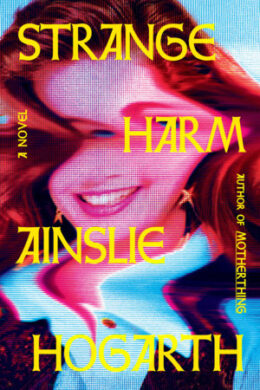
Ainslie Hogarth’s Strange Harm combines a missing-child mystery with folk horror, satire and a multigenerational story about girls whose suffering is repeatedly transformed into legend, entertainment or public identity. The central mystery concerns Janie Yearling, who vanished from the town of Gold River fifteen years earlier. Her mother, Annette, turned herself into an admired symbol of dignified maternal grief, while her father, Calvin, collapsed publicly and never stopped hoping that Janie might return. A celebrity named Starling Brenault now arrives claiming that she can help solve the case, although her involvement threatens to destroy the carefully maintained story surrounding the family.
The novel begins centuries earlier with Druda Stevenson, the fourteen-year-old daughter of one of Gold River’s founders. Druda has grown up surrounded by flattering painted portraits of herself but has never seen a clear mirror. Her father, Karl, becomes obsessed with acquiring Venetian glass and enters into a criminal arrangement with the repulsive Horace Hubbard. A man involved in transporting the glass is murdered, but Karl nevertheless brings a precious fragment home.
When Druda finally looks into it, she sees a face entirely unlike the beautiful girl represented in her portraits. Convinced that she is grotesque and that her parents have deceived her, she smashes the mirror. Karl strikes her, knocking her onto the broken glass and driving shards into her hands. Bleeding and disoriented, Druda runs to the river, where the moving water restores the softer, distorted reflection she recognises. She lies down in the mud and dies from blood loss. When Karl finds her body, his first instinct after embracing her is to search for the glass, but the river has carried every fragment away.
Continue Reading for Free
Enter your email address to unlock the article and keep reading it for free.