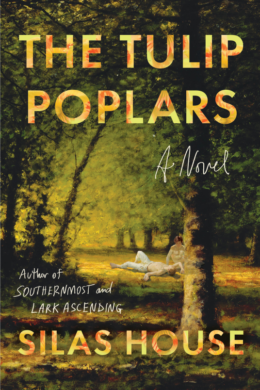
The Tulip Poplars is a sprawling Appalachian historical romance about Tom Foster, Amos Lewis, Maeve Day, and Paschal Collins, four people whose lives are shaped by forbidden love, religion, race, shame, trees, music, exile, and the long, punishing work of surviving in a place that mostly refuses to let them be fully human. It wants to be a queer epic, an interracial love story, a multigenerational rural elegy, a religious critique, a Black church novel, a New York queer-world novel, a farming novel, a labor novel, and a hymn to land. Mostly, it is an overripe sentimental machine that keeps turning every tree, mule, hymn, kiss, funeral, birdcall, and flower into a symbol of endurance until endurance itself begins to feel exhausted.
The novel opens in ruins. Bright Star, Kentucky, has decayed into memory. A wall has fallen from an old house, revealing a piano with a tulip poplar sapling growing out of it. The town’s former centers — orphanage, church, post office, boardinghouse, train platform — are abandoned. Descendants still visit the graves under the tulip poplars and press fallen blossoms between book pages. It is a pretty, obvious frame: art, nature, memory, survival, all literally sprouting from the remains of a dead community. The image is lovely, but the book never lets it be just an image. It becomes the instruction manual for everything that follows.
The main story begins in 1918, at a square dance in Bright Star. Tom Foster rides in on Daisy, his beloved mule, anxious in crowds but drawn to music and dancing. His best friend Maeve Day pulls him into the Virginia Reel. Maeve is the rector’s daughter, sharp, funny, hungry for books and for a life larger than the valley. Everyone assumes she and Tom will eventually marry. Tom loves her deeply, but not in the way everyone imagines. His real desire is for Amos Lewis, an orphan boy from the Bright Star Episcopal Institute. Amos sings at the dance, watches Tom, and beckons him into the woods. They kiss there for the first time.