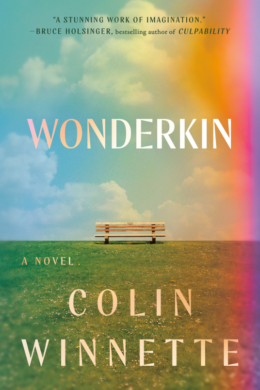
Wonderkin is a near-future robot-child custody novel about Charles Wright, a lonely widower who rents two artificial “temporary units” from a company called WonderKin, keeps them past the end of the contract, calls them his sons, and eventually destroys his own life trying to save them from being returned, recycled, or legally erased. It wants to be a novel about grief, parenthood, artificial consciousness, corporate ownership, post-pandemic loneliness, model civil rights, dementia, queer/human/nonhuman kinship, techno-religious cults, and the strange moral violence of deciding who counts as real. Mostly, it is a clever but loose and over-explained machine, forever pausing its own story so every character can explain the ethics of that story to everyone else.
The book opens with Charles hearing someone at the back door after taking one of his dead wife Rachel’s powerful sleeping pills. He has put his two “sons,” Chuck and Glen, to bed. Half-drugged, hallucinating, frightened, and desperate not to wake them, he finds a man-shaped figure trying to get inside. It is not a man but an old “model,” one of the autonomous artificial bodies that have become an everyday social presence after a Model Autonomy Agreement supposedly liberated them while leaving them regulated, monitored, and only partially free. Charles presses the safety node behind the model’s ear, puts it in “parkable,” and drags it away from the house to a nearby park.
Already the novel has its favorite trap: Charles is kind, but his kindness almost always begins with control. He wants to help the model, but first he immobilizes it. He wants to protect his sons, but protection keeps becoming secrecy, reset, confinement, and theft. In the park, still drugged, Charles talks to the model. The model says it needs an update because autonomous models can no longer access the shared network on their own. Charles promises to come back in the morning and help, then leaves it frozen on a bench.
Continue Reading for Free
Enter your email address to unlock the article and keep reading it for free.