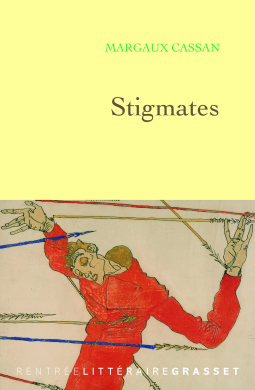
Stigmates is not really a novel, and barely even a coherent essay. It is a loose, repetitive, over-intellectualized autofictional meditation on holes, wounds, piercings, mystical crises, skin, sex, religious ecstasy, pain, performance art, and the modern body’s alleged emptiness. It begins with an ear piercing and ends with an old boyfriend announcing his marriage before the narrator suggests they enter a church, as if this circular return were enough to make the preceding two hundred pages feel structured. It is not. The book keeps confusing motif with architecture: because “trou,” “peau,” “stigmate,” “Dieu,” “douleur,” and “vide” recur constantly, it assumes it has form. Mostly, it has repetition.
The opening gives the whole problem away. “L’histoire a commencé le jour où je me suis percé les oreilles,” the narrator says, describing a music festival in Hungary where, after wandering away from her friends, she gets an acrylic butterfly earring from a piercer who tells her, “lance-toi, princesse.” Her parents hate it. Their class anxieties are expressed through ugly ethnic shorthand: no shorts because that looks German, no flip-flops because that looks Spanish, no pierced ears because that looks Portuguese. The piercing becomes infected under the bandeau she is forced to wear. Later, at the hairdresser’s, the earring is ripped out in the sink, splitting the lobe into blood, pus, sweat, wax, and hair. The description is intended to shock, but it is already doing the book’s favorite thing: making the body grotesque, then squeezing theory out of the mess.
After the torn ear, the narrator promises not to make more “trous inutiles.” From there, the book moves with all the subtlety of a seminar handout into the navel. The belly button becomes an original wound, the scar of separation from the mother, then a route into Plato’s androgynes, Zeus cutting bodies in two, Delphic omphalos symbolism, Rome, Britney Spears, and the modern desire to mark the body in order to prove it exists. This is the first of many passages where the prose looks clever only because it refuses to stop. One image cannot remain an image. It must become mythology, anthropology, pop culture, social diagnosis, and existential thesis. The result is not depth; it is overloading.