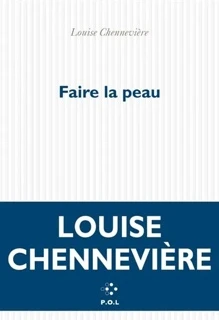
Faire la peau is less a novel than a long accusatory monologue against the narrator’s mother, and that is already one of its problems. It has no real plot engine, no scene discipline, no dramatic progression beyond repetition, and no interest in letting the reader discover anything. It begins with a provocation, circles it for nearly three hundred pages, then ends by restating it in softer lighting. The narrator has always waited for her mother to die. Not metaphorically, not abstractly: “J’ai toujours attendu la mort de ma mère.” From that opening, the book announces its whole program: daughters secretly want to kill their mothers, the mother-daughter bond is a prison, maternal love is a fiction, and the narrator must “faire la peau” to the myths that have trapped her.
The beginning is immediately overdetermined. The epigraphs from Nelly Arcan and Sylvia Plath announce shame, maternal judgment, murder, and self-destruction before the book has even started. Then the narrator spends pages insisting that she is not simply washing dirty linen in public, not merely settling accounts with her own mother, but addressing the structure of motherhood itself. This is where the book’s grandiosity becomes exhausting. Every private grievance is inflated into theory. Every wound becomes patriarchy. Every mother becomes a guard of the prison. The narrator says mothers are “les gardes-chiourmes de l’ordre patriarcal,” and the book never really moves beyond that kind of slogan.
The first concrete memories are brutal but handled with such rhetorical heaviness that they feel less revealed than deployed. At sixteen, the narrator breaks her foot by kicking a wall because she cannot hit her mother. Then a footnote immediately corrects the claim: actually, there may have been one time when she pushed her mother against a wall after the mother tore at her hair, and said, “c’est fini maintenant.” The book keeps doing this: statement, correction, qualification, meta-commentary, self-accusation, theory. Instead of creating complexity, the constant self-interruption becomes a mannerism. It is as if every sentence must prove that it knows it might be lying.
Continue Reading for Free
Enter your email address to unlock the article and keep reading it for free.