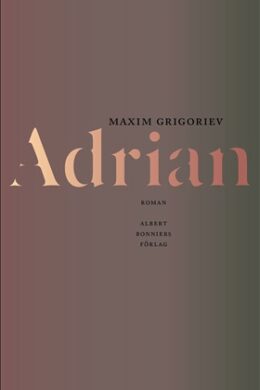
Adrian is a long, reflective novel about friendship, literary ambition, ageing, class, exile, desire, failure, and the disappearance of the world that once seemed to promise meaning. The plot moves back and forth in time, but its emotional centre is Adrian Maroof, a beautiful, awkward, intensely serious young man who wants to write a great elegiac poem and live a life devoted to literature.
The novel opens with Adrian, twenty-four years after the main youthful events, standing by the stairs down to Atlas in Stockholm, watching snow fall. This image of snow, falling, vanishing, and creating a “white nothing,” becomes the book’s central image. From there the story returns to the time when Kristian first met Adrian in Sigtuna through their mutual friend Johannes. Adrian is then about twenty, physically striking, almost painfully beautiful, but socially nervous, hesitant, and incapable of easy conversation. He is obsessed with Gunnar Ekelöf and is already working on a long elegy, a poem he imagines as clear, natural, honest, and exact.
Kristian is fascinated by Adrian immediately, though his fascination is mixed with irritation, contempt, tenderness, and sexual longing. Adrian, Kristian, and Johannes become a small literary trio in Stockholm. Through Ulrike Klatte, an older woman connected to Café Valand, Kristian and Adrian rent a one-room flat in Atlas, on Völundsgatan. The flat becomes a sacred place for Adrian: old, warm, worn, full of traces of vanished people. The three friends spend their days at Valand, in second-hand bookshops, at lectures, and in long conversations about literature, Ekelöf, language, poetry, and the idea of a serious intellectual life. Adrian dreams of becoming a poet and scholar. He writes on little slips of paper, constantly rearranging and rewriting his elegy, whose first line is “Uppright stands the pine.”