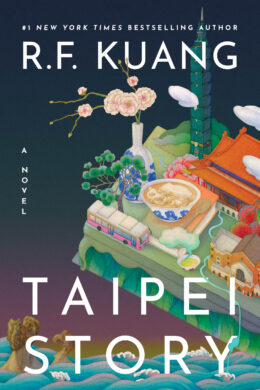
Taipei Story is a sharp, painful, funny novel about language learning, diaspora identity, grief, family history, sexual awkwardness, and the fantasy of “reconnecting” with a culture that may no longer exist in the form one imagined. Its narrator is Lily Chen, a Chinese American Yale student who goes to Taipei for a ten-week intensive Mandarin program. She was born in Guangzhou and moved to the United States young enough that Chinese became the language of childhood, family scolding, embarrassment and half-understood obligation. She arrives hoping that immersion will repair something: her Chinese, her relationship to her family, and her sense of who she is.
The novel opens with Lily at Logan Airport, noticing other Chinese American students on the same Boston–Taipei route. She recognizes their type immediately: students like her, going to Taiwan to recover a language they feel they should already know. She judges them for being Americanized, for knowing the same travel blogs and food bucket lists, then realizes her Chinese is no better than theirs. This mixture of superiority, shame and recognition drives much of the book. Lily wants to be different from other heritage learners, but she is also one of them.
Before arriving, Lily has taken placement tests for the program. She can understand bits of Chinese intuitively but panics at full paragraphs. She guesses answers, struggles with names, skips Classical Chinese, and fears exposure as a fraud. Her interviewers place her in advanced work, and she arrives in Taipei with her classmate Anna, who knows Lily only through Chinese class. Lily likes this because it means she might invent a new self in Taiwan, one unburdened by her English-speaking college identity.
Continue Reading for Free
Enter your email address to unlock the article and keep reading it for free.