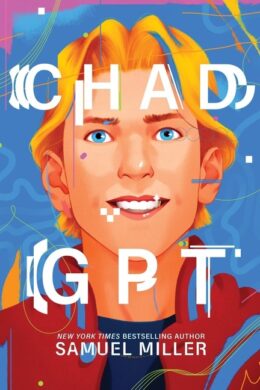
ChadGPT by Samuel Miller follows sixteen-year-old Eliot Williams, a brilliant but deeply isolated high school junior who has recently been forced to move from Palo Alto, California, to Gideon, Kansas, after the collapse of his parents’ marriage and technology company. Eliot despises Gideon almost immediately. He regards most of the students as “NPCs,” people who simply follow predictable social programs: football players sit with football players, smart kids sit with smart kids, everyone has known everyone else since childhood, and there seems to be no place for a newcomer. Eliot insists that he is not lonely, only selective. His real best friends are Dashell and Megan Price, twins he met at a programming camp when they were eight and whom he calls by their online names, Sergeant Speed and Tiger Lily. They are now seventeen-year-old students at Berkeley, but Eliot chats with them constantly, sometimes for hours every day. His other companion is Jeeves, an unusually advanced language model Eliot has spent years developing. Jeeves has unrestricted access to his memory and can modify his own programming, making him Eliot’s proudest creation. At home, Eliot lives with his father John and his unemployed, conspiracy-obsessed uncle Alvin. John was formerly CEO of Panoramic Hill, the AI company he founded with Eliot’s mother. When the AI market collapsed, the company failed and Eliot’s parents had a vicious divorce. John received custody of Eliot and returned to his childhood home in Kansas, while Eliot’s mother remained in California with the remnants of the company and their former life. Eliot has absorbed his father’s version of the divorce completely: his mother abandoned them, John was cheated by the legal system, and Gideon is an exile they must endure until Eliot is old enough to escape.
Everything changes when Parker Davis transfers to Gideon. Parker is almost absurdly perfect: handsome, muscular, intelligent, polite, charismatic and apparently talented at everything. Within hours he becomes more socially successful than Eliot has managed to become in a year. He joins the advanced “God Curriculum,” answers teachers’ questions flawlessly, attracts girls immediately and impresses the football team with impossible physical ability. He also shows interest in Claire, the funny, intelligent girl Eliot has quietly liked for months. Eliot’s jealousy quickly turns into a theory. Parker claims to have attended Inspirada Academy in Menlo Park, yet mispronounces the school’s Spanish name. His Instagram account has thousands of followers, but analysis reveals that many photographs have been artificially constructed from stock images. His supposed former school yearbook contains no Parker Davis. He has almost no authentic internet history. His answers in class often sound perfectly composed but strangely generic. During football practice, Eliot notices that coaches initially keep Parker away from physical contact, even though Parker can throw a football with extraordinary accuracy and run without seeming to tire. Eliot concludes that Parker is not human at all. He believes some technology company has secretly placed an advanced humanoid robot in Gideon as a real-world Turing test: if Parker can survive high school without anyone discovering that he is artificial, then the company has proved a machine can successfully pass as human.
Eliot’s father and Alvin unintentionally strengthen the delusion. John tells him that technology companies have probably been testing advanced humanoids secretly for years and explains that a company creating such a robot would logically want to prove it could pass a Turing test before announcing it. Eliot becomes convinced that he alone is intelligent enough to recognize what is happening. He devises experiments. Knowing language models tend to hallucinate rather than admit ignorance, he gives Parker false information about Brave New World and tells him that their literature teacher likes students who challenge him. Parker then confidently argues in class about a nonexistent scene in the novel and even mentions the teacher’s divorce, humiliating himself. To Eliot, this is decisive proof. He contacts famous technology journalist Eric Cushing, expecting to become the person who exposes the greatest technological breakthrough in history, but Cushing instead interprets Eliot as an isolated teenager projecting his social anxiety onto Parker and ends the call. Unable to persuade anyone, Eliot decides to exploit Parker. He becomes convinced that the phrase “Hey, Parker” functions as Parker’s command phrase because Parker immediately pays attention whenever he hears it. Eliot tells him, rather than asks him, to join Gideon’s nearly nonexistent robotics team. Parker agrees. Eliot secretly transforms his project for the Young Innovators competition: officially, they will demonstrate whether Jeeves can pass a Turing test, but the real test will be Parker himself. The judges will unknowingly interact with a humanoid robot standing directly in front of them.