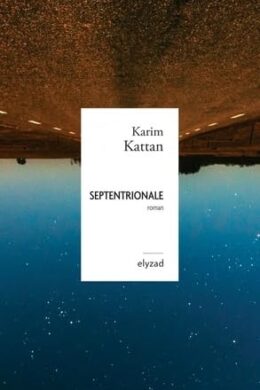
Septentrionale is a one-night apocalyptic road novel that follows two strangers, Joseph and Maryam, as they drive north through a collapsing, barely disguised war-torn country while the sky opens, the ground shakes, cities empty, the sea glows, and everybody talks about love, exile, violence, family, borders, memory, and the mystical pull of the North Star. It is short, but it is not concise. It stretches one drive into a long symbolic séance, and almost every object is required to carry a burden of meaning it cannot plausibly hold: apples, headlights, candy, old men, cars, forests, dolphins, clocks, mothers, checkpoints, names, rivers, stars, and, most insistently, the north.
The novel begins in winter twilight, with the memory of Joseph and his lover Nour walking through Urusalim, “city of dusk,” where night once felt intimate, erotic, and protective. Joseph and Nour’s relationship is already half elegy: Nour is beauty, domestic order, dirty glasses, carefully folded underwear, and a life Joseph both loves and wants to escape. In the next movement, Maryam is leaving Iunu, the southern capital, in her car. She thinks of Hind, her estranged wife or almost-wife, who has gone north to Áslo, and of Hind’s brother Younis, whose fate has cracked her life. Maryam knows, from long experience of war and family terror, how to read catastrophe before others admit it. Her abusive mother taught her that skill: violence arrives first as a change in the air.
The central premise is simple. The country is ending. Not metaphorically, or not only metaphorically. Bombardments, soldiers, colonists, collapsed communications, rumors of massacres, and supernatural disasters merge into one national death event. People are fleeing north toward Ijon and Arqa. Checkpoints have failed. Borders have stopped functioning, or at least stopped pretending to be orderly. The old machinery of occupation, humiliation, and passage has broken open. For one night, there is a strange freedom: one can drive through the whole country. This ought to give the novel momentum, but the book keeps stopping the car so someone can experience another revelation about grief.