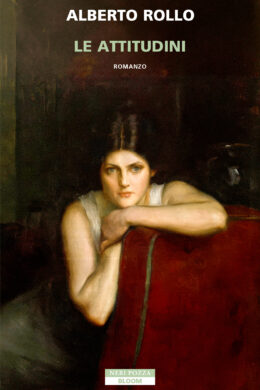
Le attitudini is a historical-archival romance about two marginal young people caught in the fever of late-eighteenth-century Europe: Bruno Röder, a sickly German youth drawn toward Jena Romanticism, and Marianna “Nenna” Di Dio, a Salentine orphan educated in Naples under the dazzling shadow of Emma Hamilton. It wants to be a novel about youth, revolution, letters, Romanticism, women’s education, class ascent, performance, illness, and the way private lives are swallowed by History. Mostly, it is a bloated pseudo-archive that turns a potentially strong story into a museum of references, letters, fragments, epigraphs, names, and solemn commentary.
The framing narrator is an ageing former professor who has stopped teaching and spends his days in his study while his wife leaves flowers on his desk. He is obsessed with Jena, the German university town that briefly became the centre of European intellectual youth before Napoleon’s victory destroyed the old world and Hegel watched history ride by on horseback. The professor discovers a packet of letters between Bruno Röder of Fliederoda and Marianna Di Dio of Scantara. The letters allegedly survived the Dresden bombing in a metal box, travelled through obscure scholarly hands, and were later connected to a taccuino found in an old wardrobe in a Salentine palazzo. The apparatus is deliberately elaborate, and also deeply tiresome: the novel spends too much energy convincing us that its invented papers have a pedigree.
The first Bruno letters establish the basic problem. He has returned from Italy to Thuringia in 1793, lovesick after meeting Nenna at Palazzo Sessa in Naples, and already unable to speak without sounding like a feverish Romantic cliché. He writes of returning, never truly leaving, embracing linden trees, listening to bark, walking through countryside, imagining Nenna appearing at the end of a road, and longing for Jena. He lives with his mother, Anna Scherer Röder von Schkölen, a devout widow surrounded by her Moravian “ecclesiola,” and with Bertha, the practical household woman who understands bodies, food, cloth, sickness, and the limits of young male imagination far better than Bruno does.
Continue Reading for Free
Enter your email address to unlock the article and keep reading it for free.