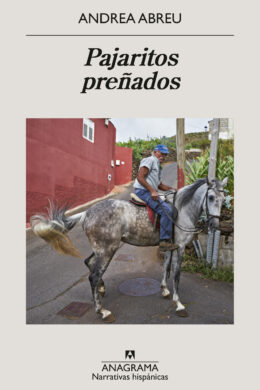
Pajaritos preñados is a huge, feverish Canarian coming-of-age melodrama about Cathaysa, a sixteen-year-old girl in a poor, wet, gossip-poisoned barrio, and the men who turn her beauty, her body, her pregnancy, and her fear into public property. It wants to be a dialect novel, a rural epic, a feminist horror story, a family-curse novel, a teenage romance, a class novel, an anti-tourism satire, and a magical-realist fable about fathers, horses, birds, potatoes, blood, and desire. Mostly, it is an overextended, language-drunk book that mistakes accumulation for force and noise for depth.
The opening is already an assault. At the village fiesta for the Virgen de El Socorro, the band dedicates a song to Cathaysa from her “novio,” even though she has no boyfriend she is willing to name. She has just turned sixteen. The whole plaza turns to look at her. Her mother Engracia has already called her a slut for going out dressed with her breasts and body visible; the men stare anyway, the old women judge anyway, and the singer keeps dragging her into a public performance of femininity she does not know how to escape. The scene is meant to be comic, brutal, sensual, collective, and threatening all at once. It is also exhausting almost immediately. Every smell, body part, insult, food stall, old woman, song lyric, religious cry, and bodily twitch is described as if the novel is afraid that leaving anything out would weaken the spell.
Cathaysa’s world is introduced through three girls and two male threats. La Macha is her closest friend, protector, almost shadow-lover, almost substitute conscience: butch, furious, practical, jealous, and far more lucid about men than Cathaysa wants her to be. Chaxiraxi is the gossipy, chaotic friend who knows more than she should and still says the wrong thing at the wrong time. El Churrero is Cathaysa’s cousin, a fifteen-year-old boy from the family churrería who has been obsessed with her since childhood and behaves as if wanting her is the same as owning her. He publicly sends the birthday song, brings her food, gives her gifts, and turns every gesture into a marriage proposal. The book keeps insisting that in El Churrero’s head, love only requires one person: him. The idea is sharp the first time. By the end, it has been repeated into bluntness.