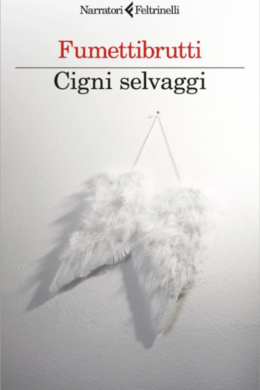
Cigni selvaggi is a grim, familiar, and often sloppily written trauma novel about Teresa, a young trans woman from Palermo who moves north to study, fails to survive economically, enters the night-club world, is exploited repeatedly, and eventually becomes a successful comics artist. The book wants to be a fairy-tale descent, a memoir-like coming-of-age story, a social novel about poverty and sex work, a trans medical trauma narrative, and a family-collapse chronicle. The problem is that it mostly just piles all of these things on top of each other until the result feels less like a shaped novel than a catalogue of injuries.
The beginning announces its intentions with no subtlety. Teresa needs money, so she searches “soldi facili,” then “soldi facili e subito,” then “come fare soldi facili e subito se sei carina no prostituzione.” It is a blunt opening, and the bluntness never really develops into complexity. She finds work as a ragazza immagine in a club called Angioletti & Diavoletti, a name so obvious that the symbolism has already exhausted itself before the first shift begins. The white wings the girls wear are meant to turn them into “cigni” or angels, but the image is immediately over-explained and then repeated until it feels like a student underline: here are the fallen girls, here is the swan metaphor, here is the fairy-tale apparatus.
Teresa’s first weekend at the club is miserable in exactly the expected way. Matteo picks her up, Roberto is absent, the house where the girls sleep is smoky and dirty, Clelia is ill and grey, Mary/Mahin is loud and helpful, and the club is full of older men paying for “consumazioni.” The book does not trust the reader to infer danger; it keeps loading the scene with red lights, sticky rooms, alcohol, hands, surveillance, and disgusting male bodies. Teresa asks Matteo directly, “devo fare pompini?” and is told no, which of course only sets up the predictable betrayal. Roberto later calls her into his office, shows her the hidden monitor through which he watches the girls changing, and assaults her after more alcohol. The scene is horrible, but it is also narratively cheap because the book has already signposted every step.
Continue Reading for Free
Enter your email address to unlock the article and keep reading it for free.